
Temporary Office Space for Construction: A Smarter Alternative to Trailers and Buildouts
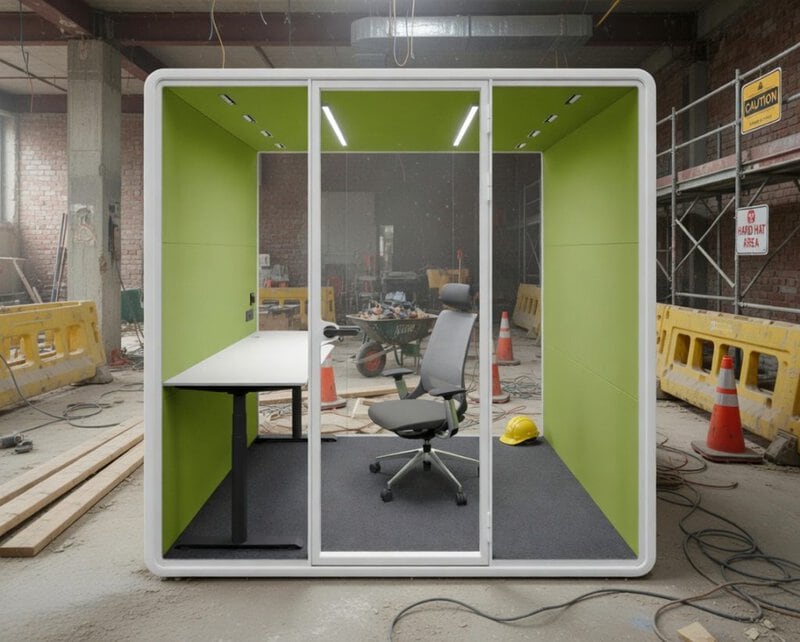
Construction projects move fast. Office space doesn’t.
That mismatch is one of the most expensive and overlooked problems in the industry. Whether it’s a ground-up development, a renovation, or a phased build, teams need a place to coordinate, meet, and operate — and they need it immediately.
That’s where temporary office space for construction comes in. But the real question is not whether you need it. It’s whether you’re choosing the right type.
Most companies default to trailers or rushed interior buildouts. Both come with delays, limitations, and hidden costs.
There’s a better way to approach it.
Why Construction Projects Need Temporary Office Space
Every construction site has the same operational requirements:
Project management and coordination
Private meetings with stakeholders
Secure storage for documents and equipment
On-site supervision and communication
Without proper workspace, productivity drops and communication breaks down.
Temporary solutions exist to solve this, but not all of them are efficient.
The Traditional Approach: Office Trailers
Office trailers have been the default solution for decades. They are familiar, widely available, and relatively simple to deploy.
But they come with trade-offs:
Limited sound control
Poor aesthetics
Setup and permitting delays
Ongoing rental costs
Lack of flexibility once installed
If you’re considering this route, it’s worth reviewing the real costs involved. This breakdown from Construction Equipment Guide explains how trailer rentals can add up over time:
https://www.constructionequipmentguide.com/cost-of-office-trailer-rental/
What looks like a simple solution often becomes a long-term expense.
The Hidden Costs of Traditional Buildouts
Some teams choose to build temporary office space inside existing structures.
This approach creates even bigger issues:
Weeks or months of construction
Permits and inspections
Waste from demolition later
High upfront costs
According to the U.S. Environmental Protection Agency, construction and demolition waste accounts for hundreds of millions of tons annually:
https://www.epa.gov/smm/sustainable-management-construction-and-demolition-materials
Temporary office buildouts contribute directly to that waste — for something that is, by definition, temporary.
A New Approach: Modular Temporary Office Space
Instead of building or renting outdated solutions, more companies are turning to modular options.
Modern temporary office space for construction is designed to be:
Delivered quickly
Installed in hours, not weeks
Fully functional from day one
Relocatable and reusable
This shifts the model from construction to deployment.
If you want to see how this works in practice, you can explore modular workspace options here:
Soundproof Home Office Pod
These systems eliminate the need for traditional buildouts entirely.
Key Advantages of Modular Temporary Office Space
1. Speed of Deployment
Construction timelines are tight. Waiting weeks for office setup slows everything down.
Modular units can be installed in a matter of hours, allowing teams to operate immediately.
2. No Permits or Minimal Requirements
Unlike traditional construction, modular solutions often require little to no permitting, depending on placement.
This removes a major bottleneck from project timelines.
3. Flexibility and Mobility
Projects evolve. Locations shift.
With modular offices, you can:
Relocate units as needed
Scale up or down based on project phase
Reuse the same units across multiple projects
This is not possible with trailers or built spaces.
4. Better Working Conditions
Construction sites are noisy and chaotic.
Modern modular offices provide:
Sound isolation
Climate control
Clean, professional environments
This improves productivity and creates a better experience for both teams and clients.
5. Cost Efficiency Over Time
While trailers may appear cheaper upfront, they create ongoing costs.
Modular offices, on the other hand:
Can be reused
Reduce downtime
Eliminate repeated rental fees
Over multiple projects, this becomes significantly more cost-effective.
When Should You Use Temporary Office Space for Construction?
You should consider modular temporary office space when:
Starting a new construction project
Managing a phased renovation
Expanding an active job site
Needing immediate workspace without delays
If your current solution involves waiting, building, or renting repeatedly, it’s time to rethink it.
Comparing Your Options
Let’s simplify the decision:
Solution | Speed | Flexibility | Long-Term Cost | Quality |
|---|---|---|---|---|
Office Trailer | Medium | Low | High | Low |
Buildout | Slow | None | Very High | Medium |
Modular Office | Fast | High | Low | High |
This is why more developers and contractors are moving away from traditional methods.
How This Connects to Your Overall Workspace Strategy
Temporary office space isn’t just a short-term fix.
It’s part of a larger shift in how space is used and deployed.
Instead of treating office space as a construction project, companies are starting to treat it as a scalable asset.
You can explore more about flexible workspace solutions here:
Backyard Office Pods
This approach aligns with:
Faster project timelines
Reduced waste
Better capital efficiency
Final Thoughts
Construction projects are already complex.
Your office setup shouldn’t slow you down.
Choosing the right temporary office space for construction is not just about convenience — it’s about efficiency, cost control, and adaptability.
The industry has relied on trailers and temporary buildouts for too long.
There are better options now.