
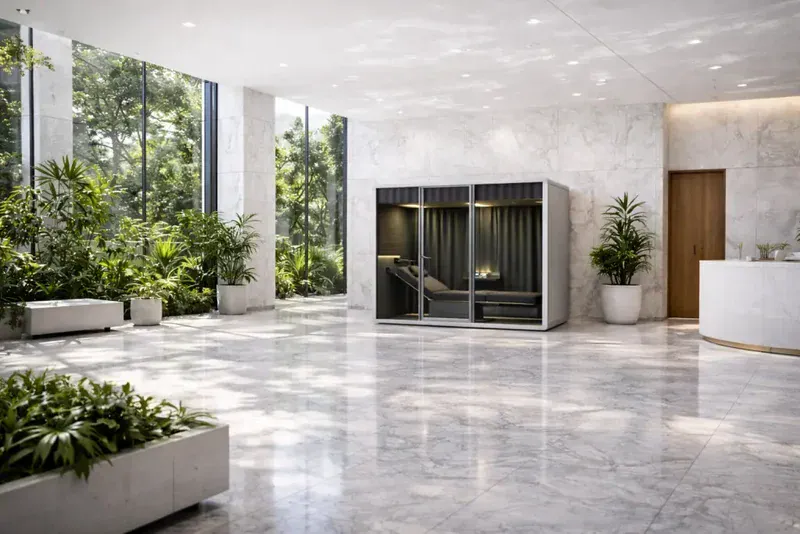
Modular Rest Pods — Why Businesses Are Skipping Construction
Building permanent quiet rooms used to be the default solution when companies wanted wellness space.
Today, many are choosing modular rest pods instead.
Not because construction doesn’t work — but because it’s slow, expensive, and inflexible.
Pods install faster, adapt to changing layouts, and avoid demolition waste down the road. That flexibility is becoming increasingly valuable.
If you want to see what modern modular private rest pods look like, this page shows the core concept:
The Cocoon | Private Rest Pods by ClarityCastle
The Problem With Traditional Buildouts
Construction projects typically involve:
Design approvals
Permits
Contractor coordination
Noise and disruption
Permanent structural changes
And once built, they’re hard to move or modify.
That’s fine if the layout never changes.
But modern workplaces change constantly.
That’s where modular rest pods make more sense.
Flexibility Is Becoming a Priority
Companies now expect spaces to adapt.
Office layouts shift.
Teams grow or shrink.
Buildings get repurposed.
Hybrid work continues evolving.
Permanent construction struggles with that pace.
Modular solutions:
Install quickly
Relocate easily
Avoid renovation downtime
Extend usable life of the investment
That flexibility is a major reason modular rest pods are gaining traction.
Offices Were Just the Beginning
Many organizations first explored pods for office use.
If you’re looking specifically at workplace applications, this page covers that:
Workplace Nap Pods — Why Rest Is Becoming Part of Workplace Design
Interest has since expanded into:
Hotels and hospitality
Airports and transit spaces
Universities
Retail environments
Manufacturing facilities
Event venues
Government buildings
Anywhere people spend time benefits from private rest infrastructure.
Supporting Employee Wellbeing Without Construction
Companies increasingly invest in wellbeing.
That includes:
Flexible work policies
Wellness programs
Better office environments
Mental health initiatives
Private rest space fits naturally into that mix.
If your focus is specifically office environments, you can see more here:
Nap Pods for Offices | Why Workplaces Are Adding Rest Pods
And if you’re looking at broader commercial environments like hospitality or retail, this page explores that angle:
Sleep Pods for Commercial Spaces | The Next Workplace & Hospitality Upgrade
Sustainability Matters Too
Traditional construction creates:
Material waste
Demolition cycles
Energy-intensive processes
Modular rest pods reduce that impact by:
Remaining reusable
Avoiding repeated construction
Supporting adaptive reuse of spaces
That aligns with many organizations’ ESG and sustainability goals.
Cost Predictability
Construction budgets often expand due to:
Unexpected structural issues
Permit delays
Labor costs
Timeline extensions
Modular pods usually provide more predictable costs and faster deployment.
That certainty is attractive to facilities managers and real estate teams.
Experience Still Matters
Flexibility alone isn’t enough.
Pods still need to deliver:
Comfort
Privacy
Acoustic performance
Professional appearance
Modern modular rest pods combine infrastructure flexibility with user experience — which is why adoption continues growing.
FAQ — Modular Rest Pods
Are modular rest pods permanent?
No. One of their biggest advantages is mobility. They can often be relocated as space needs change.
Are they expensive compared to construction?
Costs vary, but modular pods often reduce total project costs because they avoid construction, demolition, and long timelines.
Do they require permits?
Requirements vary by location and building policies, but they’re often simpler than full construction projects.
Are they only for offices?
Not at all. Hospitality, transportation hubs, universities, retail spaces, and industrial facilities are increasingly adopting modular rest solutions.
Are they soundproof?
No pod is completely soundproof, but acoustic design significantly reduces external noise and improves privacy.
Do they last long term?
Commercial-grade modular pods are designed for durability and repeated relocation.
The Bottom Line
Spaces are changing faster than ever.
Permanent construction doesn’t always match that pace.
Modular rest pods offer:
Flexibility
Speed
Sustainability
Cost predictability
Better user experience
That combination is why more organizations are choosing modular solutions instead of building fixed quiet rooms.
If you want to explore how modular private rest pods work in real environments, start here:
The Cocoon | Private Rest Pods by ClarityCastle